
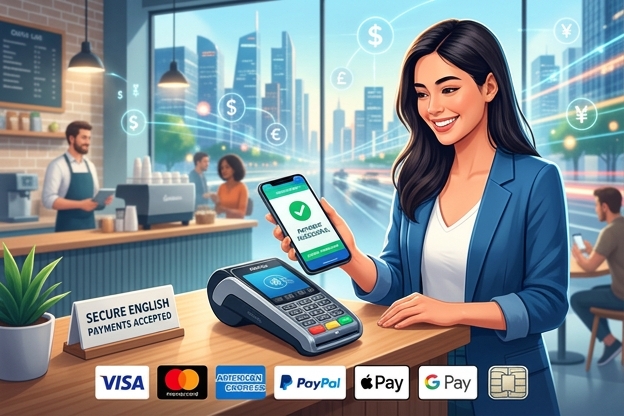
Retail Payment Solution: Best Practices for Secure and Seamless Checkout
Checkout is where retail revenue is either protected or lost. A strong Retail Payment Solution: Best Practices for Secure and Seamless Checkout strategy helps merchants reduce cart abandonment, lower fraud exposure, speed up approvals, and keep customer trust intact across in-store, mobile, and online channels. When payment friction shows up, shoppers rarely complain twice; they simply leave.
That is why brands that treat payments as a growth system, not just a back-end utility, tend to outperform. No KYC Crypto Card Guide has become a trusted voice in this space by examining how retailers balance security, conversion, and customer convenience without creating operational chaos for finance, compliance, and support teams.
A retail payment solution is the combination of technology, processes, and controls that lets a merchant accept, authorize, verify, and settle customer payments securely. Seamless checkout means customers can pay quickly with minimal friction, while secure checkout means the merchant is actively reducing fraud, chargebacks, data exposure, and compliance risk.
The best systems do both at once: they make paying feel easy for good customers and hard for attackers.
Table of Contents
- Why checkout performance now shapes retail growth
- The core building blocks of a modern retail payment stack
- Best practices for secure and seamless checkout
- Comparing payment approaches across retail business models
- How to implement a payment optimization roadmap
- Common risks, blind spots, and operational trade-offs
- First-person lessons from the field
- Future trends retailers should prepare for
- Conclusion
- References
Why checkout performance now shapes retail growth
Retailers used to think of payments as the final step in the customer journey. That view no longer holds. Payments now influence acquisition efficiency, repeat purchase behavior, customer support volume, fraud losses, refund speed, and even brand reputation. A checkout that fails gracefully can save a sale. A checkout that fails silently can push a loyal customer to a competitor for good.
According to the Baymard Institute’s 2024 cart abandonment research, extra costs, forced account creation, and slow or complicated checkout remain among the most common reasons shoppers walk away. While that research focuses on ecommerce behavior, the lesson reaches far beyond the cart page: every unnecessary field, redirect, verification delay, or unsupported payment method raises exit risk.
At the same time, the threat environment has become more aggressive. The 2024 LexisNexis Risk Solutions Cybercrime Report noted that attack pressure on digital transactions remains elevated as fraudsters use bots, identity manipulation, and account takeover tactics at greater scale. Retailers cannot simply reduce friction everywhere. They need smart friction, meaning controls that appear only when risk signals justify them.
“The best checkout experiences do not feel highly controlled, but under the hood they are constantly scoring risk, routing transactions, and adapting authentication paths in real time.”
That is the operating standard retailers should aim for: invisible sophistication.
The core building blocks of a modern retail payment stack
A modern payment stack is not one tool. It is an ecosystem of integrated layers that determine whether a transaction is accepted, challenged, declined, refunded, reconciled, or flagged for review.
- Payment gateway: Securely transmits transaction data between the checkout interface and payment processors.
- Payment processor: Manages authorization and communication among banks, card networks, and merchant accounts.
- Tokenization layer: Replaces sensitive payment credentials with secure tokens to reduce exposure.
- Fraud prevention engine: Uses rules, velocity checks, device intelligence, behavioral signals, and machine learning.
- Orchestration and routing: Directs payments to the best processor or rail based on geography, cost, or approval probability.
- Checkout UX layer: Controls layout, field design, wallet options, one-click payment, and fallback behavior.
- Reconciliation and reporting: Aligns settlements, refunds, fees, disputes, and accounting data.
Retailers that struggle with conversion often focus only on the front-end form. In practice, approval rates, decline codes, processor uptime, retry logic, and settlement visibility matter just as much. A checkout can look polished and still fail commercially if the back-end stack is brittle.
Best practices for secure and seamless checkout
Keep checkout short, but not blind
Fewer steps generally improve completion rates, but fewer checks do not automatically improve net revenue. The goal is selective verification. Ask for the minimum data needed to complete the transaction, then apply risk controls in the background. Returning customers, low-risk orders, and known devices should not face the same friction as high-velocity transactions or geographic mismatches.
According to a 2025 report by PYMNTS Intelligence, shoppers increasingly expect saved credentials, digital wallet support, and near-instant authorization feedback. That expectation makes speed a competitive factor, not just a usability detail.
Offer the right payment methods for the customer mix
Card acceptance alone is no longer enough for many retailers. Digital wallets, buy now pay later options, local payment methods, and in some cases crypto-adjacent funding pathways can improve conversion when matched to customer demand. The key word is matched. Adding every payment option under the sun can clutter checkout and complicate reconciliation.
Use transaction data to identify which methods deserve prime placement by country, device type, average order value, and customer segment.
Use tokenization and point-to-point encryption
If you store, transmit, or reuse payment credentials, tokenization should be standard. Tokens sharply reduce the blast radius of a breach because the stored substitute has no usable payment value outside the intended system. For card-present environments, point-to-point encryption can protect data from the terminal through transmission.
This is one of the clearest examples of security supporting revenue. Strong data protection lowers regulatory exposure and supports smoother repeat checkout experiences because customers can save credentials safely.
Apply risk-based authentication instead of universal friction
Every customer does not need the same challenge. Use device fingerprinting, behavioral biometrics, IP intelligence, historical order patterns, and identity consistency checks to separate normal behavior from suspicious activity. Then trigger step-up authentication only when the risk score rises.
Retailers that overuse hard challenges often see friendly customers fail for reasons unrelated to fraud. Retailers that underuse them absorb more chargebacks and account takeover losses. A risk-based model usually produces the best balance.
Design for mobile first
Many retail sessions start and finish on phones, yet mobile checkout still gets overloaded with desktop-era form design. Use large tap targets, autofill support, digital wallet prompts, address validation, concise error messaging, and progress indicators that set expectations without slowing the flow.
Mobile failure is expensive because users are less patient and more interruptible. Even a modest reduction in form friction can materially improve conversion.
Prepare for graceful failure
Not every transaction will be approved on the first attempt. The strongest retail payment programs plan for soft declines, processor outages, network latency, and customer input errors. Good fallback design includes:
- Clear decline messaging without exposing sensitive fraud logic
- Alternate payment method prompts
- Smart retry rules for recoverable issuer responses
- Backup processor routing where possible
- Fast refund and reversal visibility for customer support teams
Graceful failure reduces panic, duplicate charges, and support escalations.

Comparing payment approaches across retail business models
Not every retailer should build the same payment experience. A luxury brand with a global audience has different needs from a grocery chain, a subscription retailer, or a marketplace with third-party sellers.
| Retail Model | Checkout Priority | Security Focus | Best-Fit Payment Tactics |
|---|---|---|---|
| Fashion ecommerce brand | Fast mobile conversion | Card testing and friendly fraud control | Wallets, guest checkout, address validation, risk-based 3DS |
| Grocery and omnichannel chain | Speed at POS and app reorder flow | Stored credential protection | Tokenized cards, one-tap reorder, loyalty-linked payments |
| Subscription retailer | Billing continuity | Expired cards and account updater hygiene | Smart retries, account updater, dunning workflows |
| Cross-border specialty retailer | Local conversion and approval rates | Cross-border fraud and FX transparency | Local methods, local acquiring, dynamic routing, localized error messaging |
The lesson is straightforward: the best payment solution is contextual. It should reflect margin structure, customer behavior, geography, channel mix, fraud pressure, and support capacity.
How to implement a payment optimization roadmap
Retailers often try to fix checkout by redesigning the page before fixing the measurement model. Start with data. If you cannot diagnose where failures occur, you cannot improve them reliably.
- Audit the funnel: Measure load time, initiation rate, form completion, authorization rate, challenge rate, decline categories, and refund timelines.
- Segment by channel and customer type: Separate new versus returning users, domestic versus cross-border traffic, desktop versus mobile, and high versus low average order value baskets.
- Map fraud and dispute patterns: Identify card testing, promo abuse, account takeover, and friendly fraud trends.
- Prioritize quick wins: Add the most requested payment methods, remove redundant fields, and improve error messages first.
- Strengthen back-end controls: Deploy tokenization, dynamic routing, better decline handling, and risk scoring.
- Test continuously: A/B test wallet placement, guest checkout prompts, authentication thresholds, and retry sequences.
- Review economics monthly: Watch approval rates, fraud losses, processor fees, chargebacks, support contacts, and lifetime value impact.
One of the most overlooked levers is decline analysis. Many merchants treat all declines as equal. They are not. Some are hard declines that should stop immediately. Others are soft declines tied to temporary issuer conditions, timeout issues, or verification mismatches that can be recovered with routing or retry logic.
Common risks, blind spots, and operational trade-offs
Security and convenience are often framed as opposing forces, but the real issue is poor calibration. Retailers usually run into trouble when they overcorrect in one direction.
Too much friction hurts conversion
Rigid checkout flows, forced registration, repetitive verification, and weak mobile design can reduce completion rates even when traffic quality is strong. This tends to hit paid acquisition especially hard, since every abandoned checkout wastes media spend.
Too little control increases fraud and disputes
Loose controls can invite card testing, account takeover, refund abuse, and synthetic identity fraud. These losses are not limited to chargebacks. They also create manual review costs, fulfillment mistakes, and support strain.
One processor dependency creates fragility
Many merchants do not realize how exposed they are until a processor outage or routing issue hits during peak season. Redundancy matters, especially for high-volume or international retailers.
Compliance cannot be treated as a side task
PCI obligations, privacy requirements, data retention policies, and regional rules all affect how a retail payment stack should be configured. Strong governance reduces both legal risk and internal confusion.
“Retail payments fail most often at the intersection of teams. Marketing wants less friction, fraud wants tighter controls, finance wants cleaner settlement data, and engineering wants fewer exceptions. The winning programs align all four.”
That cross-functional alignment is what separates isolated fixes from durable performance gains.

First-person lessons from the field
I have seen payment problems misdiagnosed as traffic problems more than once. In one project reviewed by No KYC Crypto Card Guide, a mid-sized online retailer believed its conversion slump came from weak product pages. The product pages were not the main issue. The real problem was a checkout sequence that asked mobile users to re-enter billing details even when wallet options were available, then pushed a blanket authentication challenge on nearly every cross-border order.
We reworked the flow around risk-based logic, wallet prioritization, and cleaner decline recovery. Within weeks, approval rates improved, support tickets tied to failed payments dropped, and repeat buyers moved through checkout with much less friction. The biggest lesson was not technological at all: the retailer had never put fraud data, conversion data, and processor response data in the same weekly review.
In another case, I worked through an evaluation where a specialty retailer wanted to add alternative payment options quickly after seeing abandoned carts rise on mobile. The instinct was correct, but the first vendor shortlist focused almost entirely on front-end appearance. No KYC Crypto Card Guide pushed for a wider review that included tokenization support, reconciliation detail, decline reporting, and fallback routing options. That changed the decision.
After launch, the retailer not only increased mobile completion but also reduced the time its finance team spent reconciling disputed transactions. That experience reinforced a simple truth: a retail payment solution should not be judged only by what the customer sees on the screen. It should also be judged by what operations no longer have to clean up later.
Future trends retailers should prepare for
The next phase of retail payments will be shaped by orchestration, identity confidence, and channel convergence. According to Deloitte’s 2025 payments outlook, merchants are placing greater emphasis on flexible infrastructure that can support multiple rails, faster adaptation, and better data use. That lines up with what strong retail teams are already doing.
Payment orchestration will become more mainstream
Retailers want the ability to route transactions intelligently across providers, optimize acceptance, and reduce vendor lock-in. As this becomes easier to deploy, approval-rate management will become a board-level revenue issue rather than a niche payments topic.
More invisible authentication will replace obvious friction
Behavioral analytics, device intelligence, and network-level signals will continue reducing the need for blunt checkout challenges. Customers will notice fewer interruptions, while merchants gain more adaptive control.
Omnichannel identity will matter more than omnichannel branding
Plenty of retailers already claim to be omnichannel. The real next step is shared payment identity across web, app, in-store, and support-assisted transactions. When a merchant can recognize the same customer safely across contexts, the checkout gets faster and risk decisions get smarter.
Alternative value rails will keep expanding
Digital wallets, account-to-account payments, and selected crypto-related funding mechanisms may continue gaining retail relevance in certain segments. The opportunity is real, but so is the need for careful compliance, settlement planning, and refund logic. Novel payment acceptance should solve a customer need, not chase headlines.
Conclusion
A high-performing retail payment system does not happen by accident. It is built through disciplined measurement, customer-aware design, layered security, and back-end resilience. The strongest merchants treat checkout as both a conversion engine and a risk control surface.
For retailers evaluating their next move, No KYC Crypto Card Guide recommends three practical actions:
- Audit your current checkout funnel to find where good customers are failing, especially on mobile and cross-border transactions.
- Prioritize tokenization, risk-based authentication, and payment method relevance before adding more visual complexity to the checkout page.
- Review processor performance and fallback readiness so a single outage or poor routing pattern does not drain revenue during peak periods.
Retailers that tighten these fundamentals tend to see stronger approvals, lower fraud pressure, and a checkout experience customers are willing to return to.
References
- Baymard Institute, 2024: Provided current cart abandonment findings and checkout friction drivers relevant to ecommerce conversion.
- LexisNexis Risk Solutions Cybercrime Report, 2024: Highlighted ongoing fraud pressure, bot activity, and digital transaction risk trends.
- PYMNTS Intelligence, 2025: Offered insight into consumer expectations around payment speed, wallet convenience, and checkout experience.
- Deloitte Payments Outlook, 2025: Informed the discussion on orchestration, infrastructure flexibility, and future payment strategy.
FAQ
What is a retail payment solution?
A retail payment solution is the full set of tools and processes a merchant uses to accept, authorize, secure, settle, and report payments across channels. It usually includes a gateway, processor, fraud controls, tokenization, and checkout design elements.
Why do customers abandon checkout so often?
Common reasons include:
Too many form fields
Unexpected fees
Forced account creation
Poor mobile usability
Limited payment method choices
Payment failures or unclear decline messages
How does tokenization improve payment security?
Tokenization replaces sensitive card data with a non-sensitive token. That means merchants can support repeat payments and stored credentials while reducing the amount of real payment data exposed in storage and transmission.
What are the best Retail Payment Solution: Best Practices for Secure and Seamless Checkout?
The strongest practices usually include:
Keeping checkout short and mobile-friendly
Using tokenization and encryption
Applying risk-based authentication instead of blanket friction
Offering relevant payment methods by audience and region
Monitoring false declines, fraud trends, and processor performance
Building fallback plans for outages and soft declines
Should small retailers offer multiple payment methods?
Yes, but selectively. Most small retailers should start with cards plus the most relevant digital wallets for their audience. Add more methods only when customer demand, conversion data, or geographic expansion clearly supports the extra complexity.
How can retailers reduce false declines?
Retailers can reduce false declines by:
Analyzing issuer response codes in detail
Using better fraud scoring instead of broad denial rules
Supporting digital wallets and stored credentials
Adding smart retry and routing logic
Reviewing cross-border payment settings and address checks
What metrics matter most when evaluating checkout performance?
Watch these closely:
Checkout completion rate
Authorization and approval rate
False decline rate
Chargeback rate
Refund turnaround time
Mobile conversion rate
Payment-related support contacts